
Photo by Mori Hiroki
Art Festival:minami-osu ECHOES
Untitled
Mixed media
Installation dimensions
2026
Minousasyouten (Aichi)
This work is a device for observing the past and the present.
In the space on the first floor, I have installed an object modeled after a signboard, bearing text that once introduced the lantern shop that operated here. The light illuminates a scene from the past that has become increasingly difficult to perceive with the passage of time, functioning as a device that redirects the viewer’s gaze from the present toward the past.
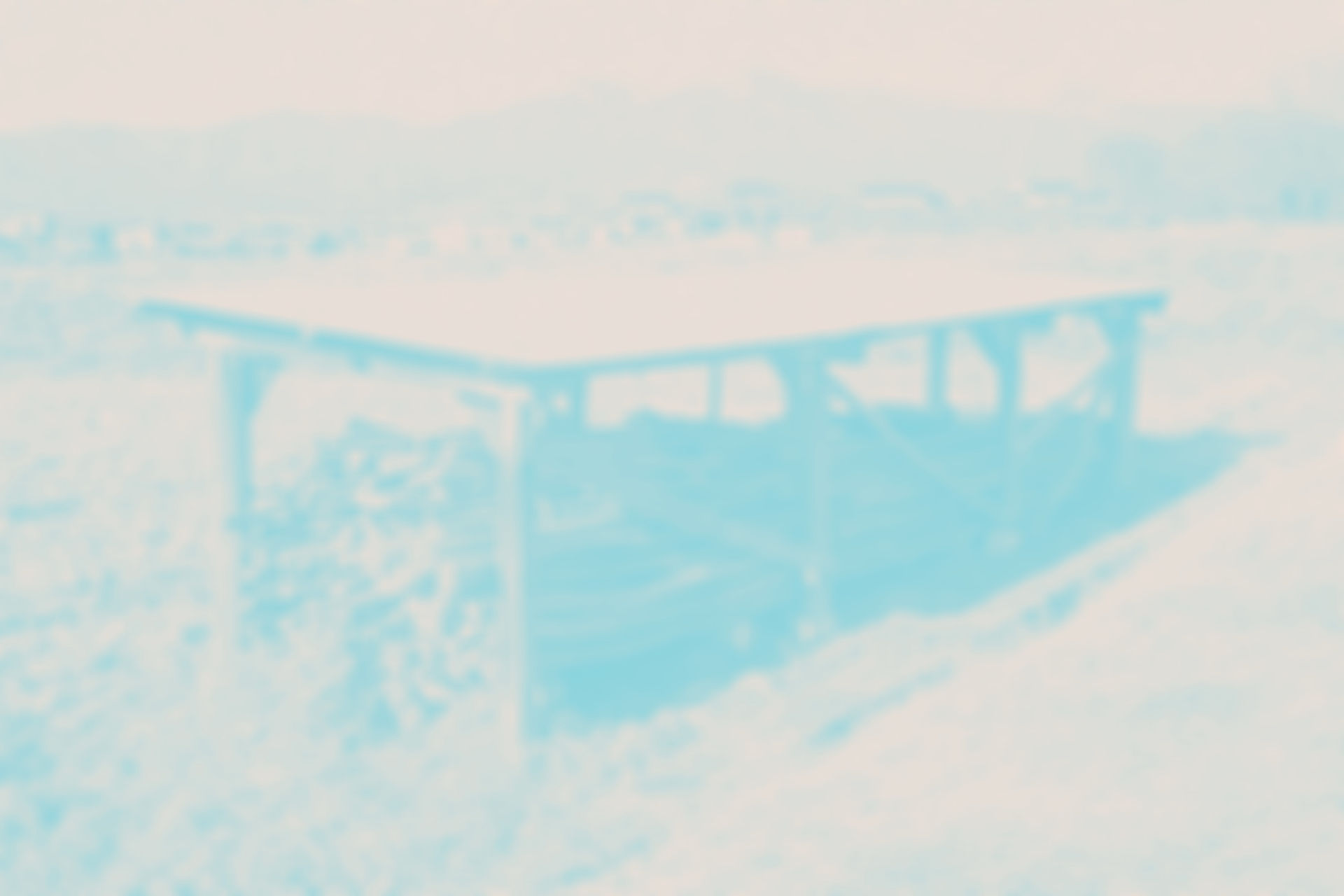
Beside it, the line of sight of a telescope extends across the first-floor space. At its far end is a monochrome photograph of the former storefront. The photograph is difficult to perceive with the naked eye; it can only be clearly seen by looking through the telescope.
The form of the telescope, stretching across the space, represents the “time” that has passed from then to now, as well as the “lives and activities of people” that have accumulated in this place, bringing them together as a single form of “distance.” The telescope thus functions as a kind of time-travel device, allowing the viewer to observe the past from the present.
For this exhibition, I have tried to intervene as little as possible in the things that already existed at the site.
The bundle of bamboo in the center of the first floor is one such element.
The shop is no longer in operation, and no one lives in the building. Yet in its courtyard, bamboo continues to grow vigorously. Cut bamboo is left casually in the space, without even being placed into garbage bags.
Walking through Osu, I sometimes encounter spaces with an atmosphere that is difficult to put into words. A coin-operated parking lot appears within the grounds of a temple. There are places that can only be reached by passing through someone’s property. Old and new buildings stand tightly beside one another, as if confronting each other.
In my own installation practice, I have often found myself placing artworks and dismantled fixtures both inside and outside my home, where they seem to contend for space with one another. Somehow, these objects create an indescribable and delicate “in-between” space.
I felt a similar quality in the bamboo and the space that had emerged around it at this site. Although this is a stranger’s house, a place where I have never lived, I felt as though it was filled with a peculiar sense of comfort and familiarity.
On the second floor, I installed a fixed-point camera using a handheld video camera.
Compared with the first floor, the second floor has a weaker sense of human presence, and at first glance, it seems as though time itself has stopped.
Yet when the viewer looks through the telescope, what appears is the “landscape of now” displayed on the LCD screen of the handheld camera, together with a time display marking the passing of each second.
Here, the viewer observes the “present”—something that could not be consciously perceived on the first floor.
The act of “observing the present” is an attempt to make us recognize once again the existence of the time in which we are living, a time that can easily be forgotten when we do not consciously attend to it.
Time continues to flow even at this very moment. Each passing second, too, accumulates here, becoming part of the history of this place.
The history of Osu, which has continued from the past into the present, does not exist only in what has already passed. The time in which we are living now is also accumulating as part of that history.
In this work, I have sought to avoid imposing judgments or emotions of affirmation and denial toward what might conventionally be regarded as “old” and “new.”
What can be seen. What cannot be seen.
What once existed. What exists here now.
Through the act of observing the distances and time that exist between these things, I hope to gain a deeper understanding of the lives and activities that have accumulated in this place called Osu, as well as the landscape that exists here today.

Group Exhibition:Parallaxis -平行線は永遠で交わるだろうか-
やわらかな風が吹くこの場所で
Gold leaf, plaster, wood, fabric, oil-based paint, tinplate, acrylic sheet
nstallation dimensions
2025
Matsuzakaya Nagoya 8F ART HUB (Aichi)

Art Festival:Matsuzaka Culture Street 2024
Good hunting
Wood, oil-based coatings
nstallation dimensions
2024
Former Residence of Hasegawa Jirobei (Mie)

Solo Exhibition
LOOK UP TO THE UNIVERSE
paraffin wax, wood, cloth, water-based paint, electric decoration
Installation dimensions
2023
studio VIICON (Aichi)

Art Fair:ART OSAKA 2023 EXPANDET
Walking with the story of the stars
ceramic clay, wood, water-based paint on wooden boards, electric decoration
H2500 × W9000 × D9000 (mm)
2023
Namura Shipbuilding (Osaka)

Group Exhibition : In the Mirrors of Planets ー惑星の姿見の中にー
Blueprint Solar System / No.1
Oil-based ink, paper / Wood, oil-based ink
nstallation dimensions
2023
Aichi Prefectural University of Arts Satellite Gallery SA・KURA (Aichi)
Exhibition organized by Rina Murao, Associate Professor in the Sculpture Department at Aichi University of the Arts (2023)
Four artists participated in this exhibition, exploring the theme of the universe. I presented two works
Blueprint Solar System:
Who designed this Earth, our solar system, and the universe itself?
Here on our Mother Earth, the conditions necessary for life have been sustained through its remarkably precise distance from the Sun.
Are there other planets like Earth somewhere in the universe?
Is there someone there looking up at the same sky?
No.1:
A friend of mine who was not particularly familiar with art once asked me, “Why is art so amazing? What makes it so important?”
I could not answer immediately. But at that moment, I suddenly thought of Voyager 1.
Voyager 1 is a spacecraft sent into space to explore beyond the solar system. On board is the Golden Record, a disc containing information about humanity—including images, sounds, music, languages, and other aspects of life on Earth. It was created so that, if an extraterrestrial intelligence were ever to discover it, the record could offer clues about who we are.
Among the information recorded on the Golden Record, there is also a small selection related to art.
I told my friend that perhaps we could begin to understand why art matters by asking ourselves a simple question:
Why was art included in a record intended to explain humanity to extraterrestrial life?
Perhaps art is one of the ways in which human beings communicate what we have seen, what we have felt, and what we have imagined.
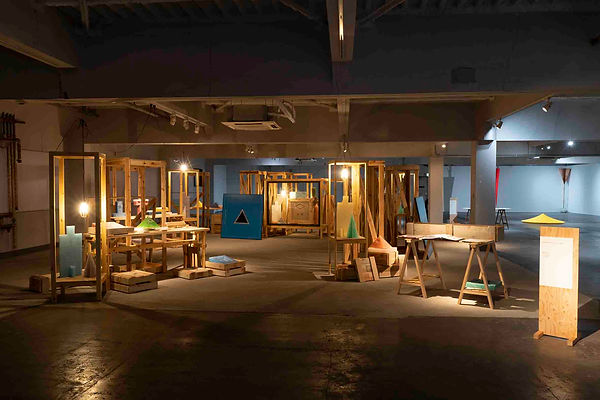
Art Fair:ART OSAKA 2022 EXPANDET
World architect and our steps
paraffin wax, wood, cloth, water-based paint, electric decoration
H2300 × W9000 × D9000 (mm)
2022
Namura Shipbuilding (Osaka)
In my attempts to communicate with people who lived on Earth in the distant past, I have repeatedly engaged in research and artistic practice. Through this process, I came to understand that the movements of celestial bodies and the presence of stars played an important role in their religious beliefs and social systems.
Yet, despite understanding this intellectually, I suddenly realized that I myself had hardly ever truly looked at the night sky.
Who, then, were they communicating with?
Holding a book filled with the names of stars, I look through a telescope. Yet not a single one of the countless names before me remains in my mind.
So I decided to reverse the direction of communication.
Rather than searching for what they were trying to tell us, I began to ask myself what I could tell them. What would I want to talk to them about?
As I did so, an unexpected number of words, thoughts, and inspirations began to emerge, scattering within me like stars across the night sky.
At first glance, they appear to be scattered without order. Yet just as stars do not exist entirely in isolation, but are drawn together by immense gravitational forces and drift through the universe as part of larger structures, perhaps the countless thoughts that emerge within me are also connected to one another by forces that cannot be seen.
I think of the Great Attractor as one such force.

MFA Graduation Exhibition
WE ARE HEADING TO THE SUNSET
cement
H2500 × W10000 × D10000 (mm)
2021
Aichi University of the Art (Aichi)
What was necessary for human beings to build the civilizations in which we live?
If experts from different fields were to consider this question, they might point to a wide range of factors: land, population, language, technology, systems, and so on.
Then, what might we discover if we approached this question from the perspective of art?
Through my studies as an undergraduate and graduate student, I have come to believe that the “power of imagination,” and more specifically, the “power to create fiction,” is fundamental to the formation of human civilization.
Borders, money, nations—these are concepts that cannot be physically seen, yet they have an enormous influence over the way our societies function. How did such concepts first emerge, and how did they come to possess such immense power?
What might their most primordial forms have looked like?
For example, perhaps the emergence of the concept of a “straight line” within a natural environment composed largely of curves offers one possible clue. Humans imagine something that does not exist as such in nature, share that idea with others, and eventually come to treat it as something real. Perhaps it is through such accumulations that civilization has been constructed.
Where, then, are we heading as we continue to face countless problems?
It may be difficult to find a direct answer. Yet by examining what human beings have imagined, created, and how they have come to perceive the world, perhaps we can begin to see the contours of the path that lies ahead.
Through my artistic practice, I seek to explore the origins of human imagination and our capacity to create fiction, while continuing to question what it means to be human—and where we, as a species, are heading.


MFA Midterm Exhibition
Packaging
The Square Town1,2,3,4
Wood, Cement
Installation Size
2020
Aichi University of the Art (Aichi)
Packing :
This work was presented as part of a graduate research exhibition.
During my graduate studies, I expanded my perspective to fields such as human history and archaeology, exploring through my artistic practice the question, “Where did humans come from, and where are we going?”
Each box in this work is designed to be large enough to contain a life-sized human or horse. Through these containers, I sought to visualize the physical presence and spatial volume of the beings they might hold, while also considering the boxes themselves as vessels for carrying something from one place to another.
The act of containing, carrying, and sending something toward an unknown destination is embedded within these objects. The boxes are not simply containers; they emerge as “vessels for a journey,” holding traces of existence while suggesting movement toward somewhere beyond.
TheSquare Town 1,2,3,4
When did the human capacity for imagination begin, particularly our ability to create “fiction”?
How did humans come to discover straight lines within a natural environment shaped by curves?
In my search for an answer, one of the places I arrived at was Turkey. In ancient times, people there worshipped the “cube.”
Reflecting on this distant past, I created cubes myself, then dismantled and rearranged them to form a city. By placing my own body within this constructed space, even if only symbolically, I sought to experience a fragment of the “fiction” that ancient people may have discovered.

BFA Graduation Exhibition
IIIIIIIIIIIIIIIIIIIIIIIIIIIIIIIIIIII
Cement, gravel
H2000 × W5600 × D5600 (mm)
2019
Aichi University of the Art (Aichi)
This work was exhibited at the Graduation and Completion Exhibition of Aichi University of the Arts.
At the center of a field formed by small stones stand 36 cement columns. Each column represents the accumulation of written information that humanity has built up throughout its history.
The spaces between the columns, however, represent what cannot be contained or expressed through written information. The work seeks to shift our attention toward the invisible and the unknown that exist beyond what we can perceive and record.
The ability to imagine and seek out what cannot be seen is one of the fundamental capacities that emerged through the Cognitive Revolution of Homo sapiens. It is this capacity that has shaped the foundations of the society in which we live today.